

PSV is marking 75 years of freedom in Eindhoven between Sept. 12 and 18. Every day online we tell stories about the club in wartime. In part 5 all about the Saint Nicholas bombing of the city.
In the early afternoon of Sunday, December 6, 1942, the population of Eindhoven was taken completely by surprise by a heavy bombardment of the Philips factories in Strijp and on the Emmasingel. With "Operation Oyster," the Allies tried to deal a blow to the German war industry.
The air attack is carried out at 12:35 p.m. by 89 Royal Air Force (RAF) fighter planes from England and lasts about fifteen minutes. Within fifteen minutes, the headquarters of Philips is virtually destroyed and the factories on the Emmasingel and in Strijp are severely damaged. A number of British bombs miss their target and land on the Demer and the Binnenziekenhuis in the heart of Eindhoven. A total of 150 people are killed. Hundreds are also wounded. A small stroke of luck: if the action had been carried out on a weekday, the number of casualties would have been many times higher.
Frits Philips is staggered and overcome by strong emotions when he arrives at the city center on his bicycle to take in the damage with his own eyes. "But," he says, "I could understand. I realized immediately that the war against the Germans had to be fought hard if it was to be won, and that reconciled me to this hellish spectacle.'
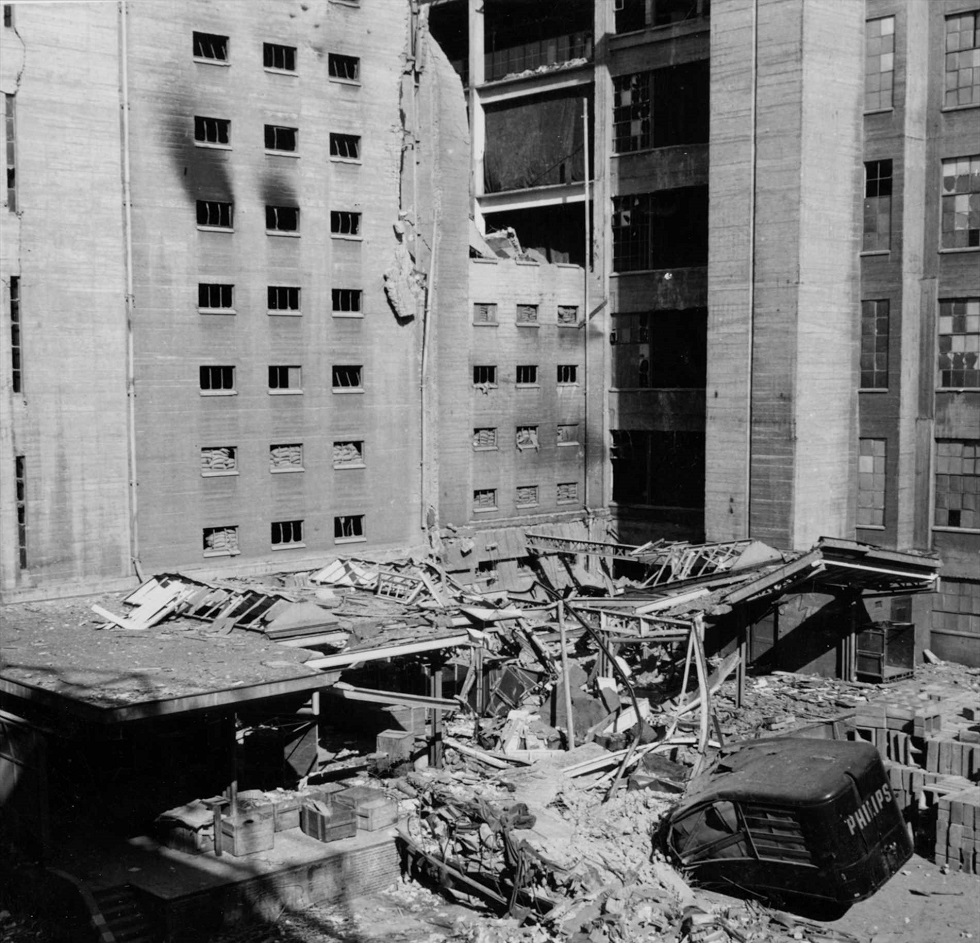 Damage to one of Philips 's properties in Eindhoven after RAF bombing | © Philips Company Archives
Censorship
Reports appear in the censored Dutch press - including the Dagblad van het Zuiden - that try to shed a completely different light on the war situation. These pieces are often literally translated from the Deutsche Zeitung in den Niederlanden, published between May 1940 and May 1945. The newspaper emphasizes that the Inner Hospital was hit especially hard and that the "indiscriminate dropping of bombs caused innocent civilians to become victims, especially women and children.
Apparently to reassure the population of Eindhoven, shortly after St. Nicholas, the Hitler-Jugend organized a grand toy campaign at the Philips Relaxation Center (POC) for children of fathers fighting at the front. These children can come to the POC to pick up free toys.
From New York, Anton Philips reacts heavily to the action. Not only does he note that his life's work has been destroyed, but he now fears the deportation of thousands of workers to Germany to work. This fear turns out to be well-founded: a total of some three thousand Philips employees, mostly aged 18 to 20, will be deported.
Ludwig Nolte, the man who monitors the planning and production of Philips in Eindhoven on behalf of the Germans, travels directly to Berlin to discuss the consequences of the attack. He is told by the Nazi regime, that the Philips factories will be rebuilt.
A second British bombing raid on the factories of Philips followed on March 30, 1943. The consequences for the company were limited, although the Fellenoord was severely hit by drifters. The second bombing also aroused fear among employees who feared that they might be hit by new bombings while working.
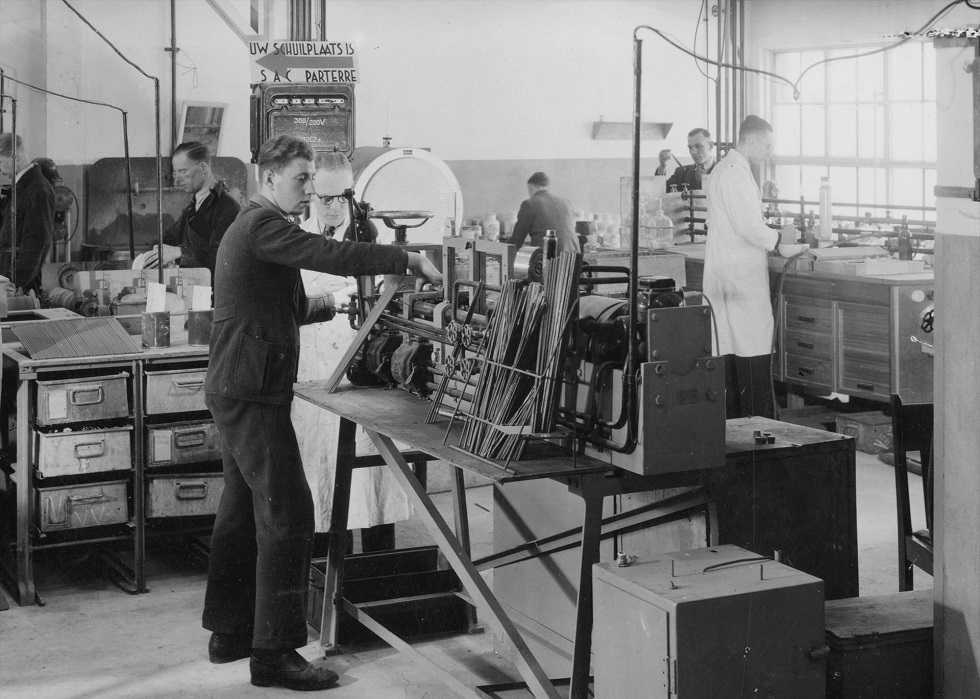 Philips employees, including PSV workers, always know the shortest way to the shelters while working | © Philips Company Archives
Strike
On April 30 and May 1, almost all Philips employees go on strike. The strike is part of a nationwide action against the German plan to take 300,000 former Dutch soldiers back into captivity and deport them to Germany. In response to the strike, the Staatssicherheitsdienst (SS) then carries out seven arbitrary arrests in Eindhoven, including that of four Philips employees. Under the eyes of Nolte, these seven people are executed a few days later on the factory grounds in Strijp. This fate also hangs over Frits Philips 's head. If he does not manage to end the strike within a day, he is told, he will be executed.
An article appears in the Dagblad van het Zuiden by order of the occupying forces. It reads: 'The management of Philips NV considers itself compelled to draw the attention of all personnel to the fact that they have to resume work on Monday, May 3, punctually and on time. Those who do not do so expose themselves to the severest measures resulting from the proclamation of the standstill law. This statute of limitations has been in effect since the ordinance of January 9, 1943, and provides that the senior leaders of the SS may issue orders for prosecution and execution. Under the threat of further German reprisals, workers at Philips returned to work on May 3.
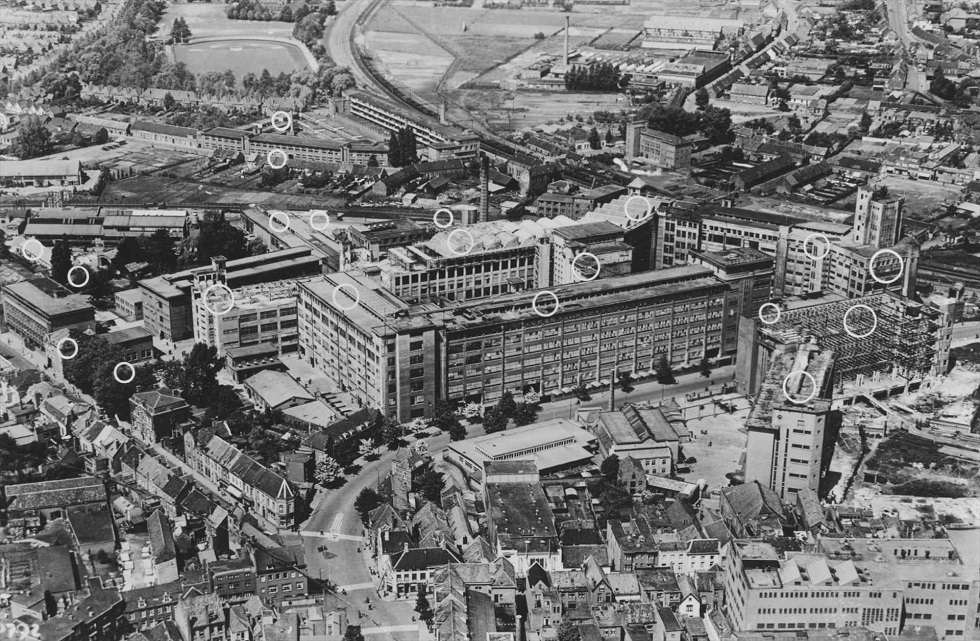 The center of Eindhoven from the air with the Philips Sportpark in the far upper left. The circles indicate the bombs slammed into the city | © Philips Company Archives/KLM
Bombs on the sports park
The second bombing also hits PSV's sports park. Two bombs land on the training fields and one hits the main field, where it is later dug out. The consequence of the actions is that PSV's players are no longer allowed to train by artificial light. 'We trained in a gym or did some running on the Oirschotsedijk,' recalled left calf Ad van Tuijl later. 'Because of the threat of new bombings, the pleasure of playing football was nil.'
Van Tuijl (19) is one of the young football players who advanced from PSV's own youth to the first team during the 1942-1943 season. The others are goalkeeper Lieuwe Steiger (18) and left winger Joke Mulders (19). Mulders is a tremendous talent and soon carries the nickname The Cannon of the South. He is the logical successor to Frans Roosendaal, who has been put to work in Germany. That fate also hangs over Van Tuijl's head; he is called up to work in Hamburg. His mother keeps him at home and so Van Tuijl possibly escapes a terrible fate. During a bombing of Hamburg, tens of thousands are killed.
PSV's young team cannot make a breakthrough this season either. Under the leadership of new coach Coen Delsen, a former Ajax and Blauw-Wit player, the team finished in a disappointing ninth place.
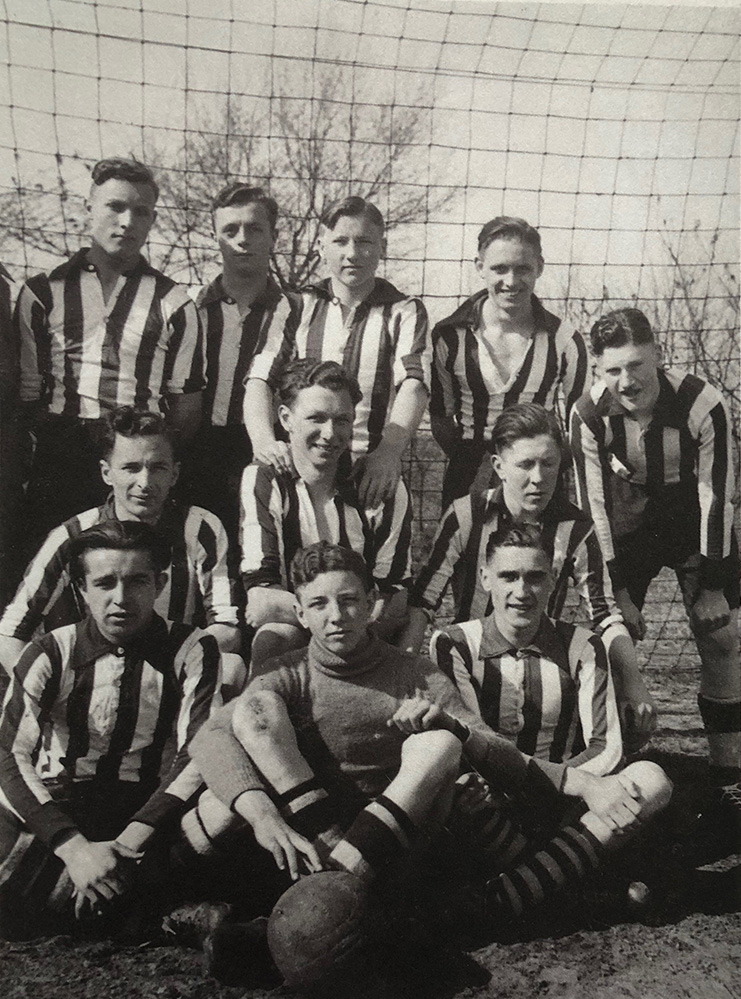 A 1941 team photo of PSV's 4th youth team, including Ad van Tuijl, Joke Mulders and goalkeeper Lieuwe Steiger | Photo from Voor Rood-Wit gezong